
Introduction
Bearings play an important role in modern mechanical and industrial systems. They help reduce friction between moving components, support loads, and ensure smooth rotational or linear movement. From small electric motors to heavy construction equipment, bearings are essential for improving machine performance and operational efficiency.
Among the different types of industrial bearings, slewing ring bearings are specially designed for applications that require rotational movement while supporting heavy axial, radial, and tilting moment loads.
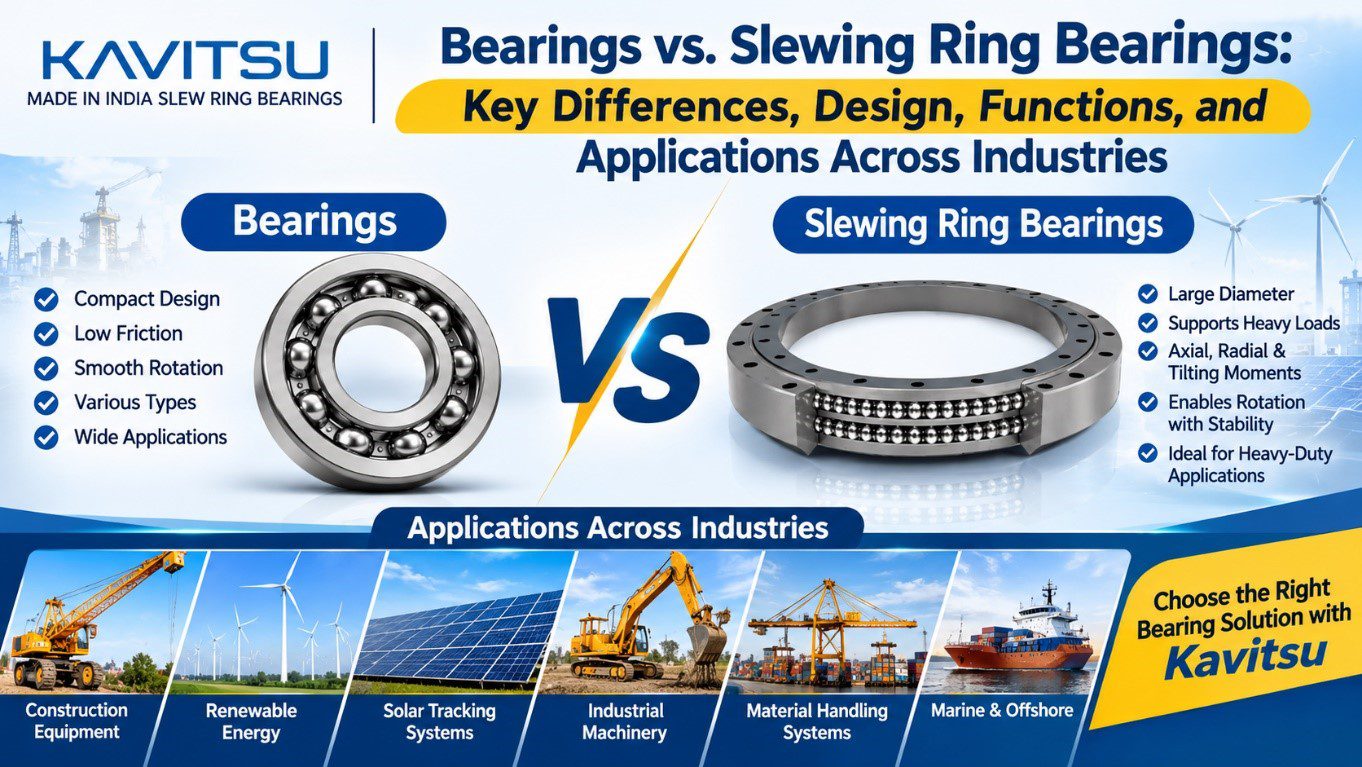
Although conventional bearings and slewing ring bearings serve similar purposes, their designs, load capacities, operating mechanisms, and industrial applications are different.
In this article, we will explore the key differences between conventional bearings and slewing ring bearings, their designs, functions, advantages, and applications across industries.
What Is a Bearing?
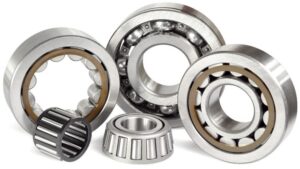
A bearing is a mechanical component designed to support moving parts and reduce friction between two surfaces. It allows controlled movement while supporting loads generated during machine operation.
Bearings are commonly used in rotating equipment such as motors, pumps, compressors, gearboxes, conveyors, and industrial machinery.
Main functions of bearings:
- Reduce friction between moving components.
- Support radial and axial loads, depending on bearing design.
- Maintain shaft alignment.
- Improve mechanical efficiency.
- Reduce wear and vibration.
- Support reliable machine operation.
What Is a Slewing Ring Bearing?
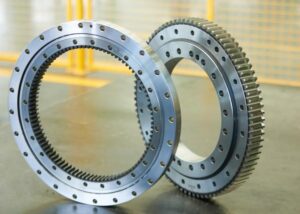
A slewing ring bearing, also known as a slewing bearing or turntable bearing, is a large-diameter rolling-element bearing designed to support heavy loads while allowing rotational movement between two connected structures.
Unlike conventional bearings, slewing ring bearings can accommodate combinations of axial loads, radial loads, and tilting moments.
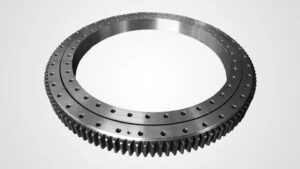
They are commonly available with internal gears, external gears, or without gear teeth, depending on application requirements.
Main functions of slewing ring bearings:
- Support heavy axial and radial loads.
- Accommodate tilting moment loads.
- Enable controlled rotation of large structures.
- Connect stationary and rotating machine components.
- Support precise positioning in industrial equipment.
Key Differences Between Bearings and Slewing Ring Bearings
Although both components support mechanical movement, they differ significantly in construction, size, and load-handling capabilities.
| Comparison Factor | Conventional Bearings | Slewing Ring Bearings |
| Design | Compact bearing assembly | Large-diameter bearing assembly |
| Size | Generally small or medium | Generally large diameter |
| Load Capacity | Depends on bearing type and size | Designed for combined loads and tilting moments |
| Movement | Supports shaft rotation or linear motion | Supports rotation between two structures |
| Installation | Usually mounted around shafts or in housings | Mounted between stationary and rotating structures |
| Gear Arrangement | Generally no integrated drive gearing | May have internal or external gear teeth |
| Applications | Motors, pumps, gearboxes | Cranes, excavators, solar trackers |
| Structure | Compact rolling-element design | Ring-shaped structure with raceways and rolling elements |
Design and Construction: Conventional Bearings vs. Slewing Ring Bearings
Understanding their construction helps determine which bearing is suitable for a particular industrial application.
- Conventional Bearing Design
Conventional bearings generally consist of:
- Inner race
- Outer race
- Rolling elements such as balls or rollers
- Cage or retainer
- Seals or shields, depending on design
The rolling elements move between the inner and outer races, reducing friction and supporting the required loads.
Common conventional bearing types include:
- Deep groove ball bearings
- Angular contact ball bearings
- Cylindrical roller bearings
- Tapered roller bearings
- Spherical roller bearings
- Thrust bearings
- Slewing Ring Bearing Design
Slewing ring bearings have a larger ring-shaped construction and are engineered to support heavy loads and rotational movement.
Their major components include:
- Inner ring
- Outer ring
- Rolling elements
- Raceways
- Spacers or cage
- Seals
- Mounting holes
- Gear teeth, where applicable
Depending on the application, slewing ring bearings may use ball or roller rolling elements.
Common configurations include single-row ball, double-row ball, crossed roller, and three-row roller slewing bearings.
Different Types of Slewing Ring Bearings
Slewing ring bearings are available in multiple designs to meet different industrial load and operating requirements.
- Single-Row Ball Slewing Bearing
Single-row ball slewing bearings use one row of balls to support combined loads. They are commonly used in solar tracking systems, light cranes, and industrial rotating platforms.
- Double-Row Ball Slewing Bearing
These bearings use two rows of balls to provide higher load capacity and support demanding operating conditions.
- Crossed Roller Slewing Bearing
Crossed roller slewing bearings feature cylindrical rollers arranged at alternating angles. They provide high stiffness and support combined loads with good rotational accuracy.
- Three-Row Roller Slewing Bearing
These bearings use three separate rows of rollers to accommodate heavy axial, radial, and tilting moment loads. They are suitable for large cranes and heavy industrial machinery.

Functions and Working Principles
How Conventional Bearings Work
Conventional bearings reduce friction by allowing rolling elements to move between the inner and outer races.
When a shaft rotates, the rolling elements move along the raceways, supporting the shaft and reducing direct surface contact.
How Slewing Ring Bearings Work
Slewing ring bearings allow one machine structure to rotate relative to another.
The inner or outer ring is fixed to the supporting structure, while the other ring rotates. Rolling elements move along the raceways to support the loads during rotation.
In geared configurations, an external drive mechanism can engage with the bearing gear teeth to produce controlled rotation.
Applications Across Different Industries
Both conventional bearings and slewing ring bearings are used across several industries, but their applications depend on mechanical design and load requirements.
Conventional Bearing Applications
- Automotive Industry: Wheel hubs, transmissions, engines, and steering systems.
- Manufacturing: Electric motors, pumps, compressors, and production machinery.
- Agriculture: Tractors, harvesters, and agricultural equipment.
- Power Generation: Turbines, generators, and rotating machinery.
- Material Handling: Conveyor rollers and industrial drive systems.
Slewing Ring Bearing Applications
- Construction Equipment: Excavators, cranes, and lifting machinery.
- Renewable Energy: Wind turbines and solar tracking systems.
- Mining Industry: Heavy-duty mining equipment and material handling machinery.
- Marine Industry: Ship cranes, offshore equipment, and deck machinery.
- Industrial Automation: Rotary tables, robotic positioning systems, and industrial platforms.
- Port Equipment: Container handling cranes and heavy lifting systems.
Advantages of Slewing Ring Bearings
Slewing ring bearings provide several advantages for heavy-duty industrial applications.
- High Load Capacity: Designed to support combined axial, radial, and tilting moment loads.
- Compact Integration: Combines load support and rotational functionality in one assembly.
- Large Diameter Design: Suitable for large rotating structures and equipment.
- Flexible Configurations: Available in different rolling-element and gear arrangements.
- Reliable Rotation: Supports smooth rotational movement when properly installed and maintained.
- Simplified Machine Design: Can reduce the need for multiple bearing arrangements in suitable applications.
How to Choose Between Conventional Bearings and Slewing Ring Bearings?
Selecting the right bearing depends on the machine design, operating conditions, and load requirements.
Consider the following factors:
- Load Type: Identify whether the application requires radial, axial, or combined load support.
- Moment Load: Evaluate tilting moments generated by the machine structure.
- Rotational Speed: Consider the required operating speed and duty cycle.
- Installation Space: Check available mounting dimensions and structural requirements.
- Operating Environment: Evaluate temperature, dust, moisture, and corrosion exposure.
- Maintenance: Consider lubrication, sealing, and inspection requirements.
- Application Requirements: Select the bearing according to machine performance and service life expectations.
For applications involving large rotating structures and significant tilting moments, a slewing ring bearing may be more suitable than a conventional bearing arrangement.
Why Choose Kavitsu Bearing for Slewing Ring Bearing Solutions?
Kavitsu Bearing offers bearing solutions for different industrial applications.
For businesses looking for slewing ring bearings, selecting a suitable bearing configuration is important for achieving reliable rotational movement and load-handling performance.
When evaluating a slewing bearing solution, consider:
- Single-row and double-row ball bearing configurations.
- Roller-type slewing bearing arrangements.
- Internal and external geared bearing options.
- Application-specific load and mounting requirements.
- Industrial requirements for construction, renewable energy, and material handling.
Kavitsu Bearing provides solutions for industrial applications where bearing performance, load capacity, and reliable rotation are important.
Explore the available products: www.kavitsubearing.com
Conclusion
Conventional bearings and slewing ring bearings are essential components in modern mechanical and industrial systems. While conventional bearings are commonly used to support rotating shafts and reduce friction, slewing ring bearings are designed for large rotating structures that require combined load support and rotational movement.
Understanding their design, functions, load capacity, and applications helps manufacturers and engineers select the right bearing for their machinery.
For applications involving cranes, excavators, solar trackers, wind turbines, and industrial rotating platforms, slewing ring bearings offer an effective solution for supporting heavy loads and controlled rotation.
Looking for reliable slewing ring bearing solutions for your industrial application?